

Place as assemblage
I perceive the place as a vibrant, open and interactive construct. It is shaped by multiple trajectories of different forces that engage in formation and identity of the place. These forces include both human and non-human agents, whose presence and actions leave traces that contribute to the formation of the place. This perspective aligns with Doreen Massey's concept of the place as a "throwntogether".
According to this perspective we can view the place as a palimpsest where different overlapping layers that tell its complex history. Nevertheless, the notion of a palimpsest is quite static. Instead, I prefer the concept of the place as assemblage, as proposed by Kim Dovey. The most general sense an ‘assemblage’ is a whole "whose properties emerge from the interactions between parts" (De Landa 2006: 5). Therefore, the place as an assemblage is continuously evolving, undergoing processes of deterritorialization and territorialization influenced by the desires of both human and non-human agents. This dynamic environment gives rise to our habitus, shaping our behavior and experiences.
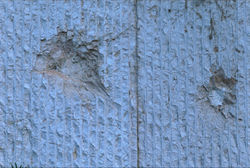
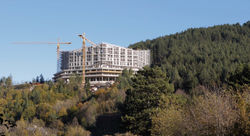
The borderland, in particular, is an exceptional space that highlights the characteristics of separate communities divided by religion, ethnicity, and ideology. It is also a space where nature regains its freedom in the absence of human presence. Borderland as an assemblage encompasses multiple layers of historical and present identities, as well as micro and macro politics, emotions, and aesthetics. In my installation, I specifically dissect and explore the various layers of the places, performing sort of vivisection, cutting through strata of architectural and natural tissue of places located along the IEBL.
Vraca
 |  |
|---|---|
 |  |
 |  |
 |
 |  |
|---|---|
 |  |
 |  |
 |  |
 |  |
Trebevic
